Our Maths Curriculum
"Mathematics is not about numbers, equations, computations or algorithms: it is about understanding" - William Paul Thurston
Mathematics is everywhere. It helps us make sense of the world, solve problems, spot patterns and think logically. From telling the time and handling money to measuring, calculating and reasoning, maths is an essential life skill. At Coberley, we aim to develop confident, resilient mathematicians who enjoy challenge, think critically and can apply their learning in a wide range of contexts.
We believe that every child can succeed in mathematics. Through a carefully sequenced curriculum, children build secure foundations in number and calculation before applying their understanding to increasingly complex concepts. We encourage children to explain their thinking, justify their answers and develop a deep understanding of mathematics rather than simply learning procedures.

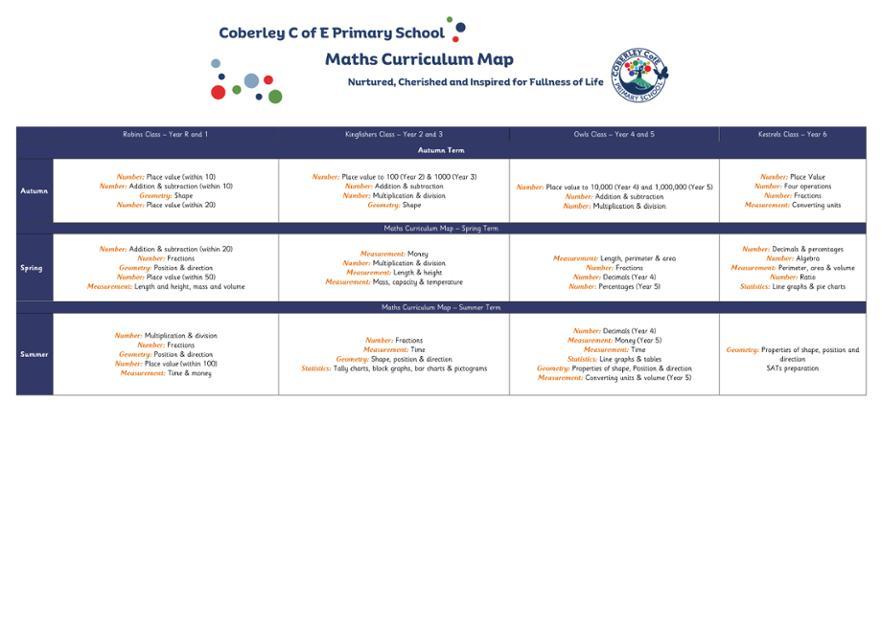
|
Maths Curriculum Map | [pdf 138KB] |

|

Mathematics at Coberley
Mathematics is everywhere. It helps us make sense of the world, solve problems, spot patterns and think logically. From telling the time and handling money to measuring, calculating and reasoning, maths is an essential life skill. At Coberley, we aim to develop confident, resilient mathematicians who enjoy challenge, think critically and can apply their learning in a wide range of contexts.
We believe that every child can succeed in mathematics. Through a carefully sequenced curriculum, children build secure foundations in number and calculation before applying their understanding to increasingly complex concepts. We encourage children to explain their thinking, justify their answers and develop a deep understanding of mathematics rather than simply learning procedures.
Teaching for Mastery
Our lessons are structured around three key elements:
Fluency
Children develop secure recall of key facts and efficient calculation strategies. Fluency allows pupils to work accurately and confidently with number and provides the foundation for deeper mathematical understanding.
Reasoning
Children are encouraged to explain their thinking, justify answers, spot patterns and make mathematical connections. Through discussion and debate, pupils learn that there is often more than one way to solve a problem.
Problem Solving
Pupils regularly apply their mathematical knowledge in a variety of contexts and challenges. We encourage perseverance, resilience and creativity when tackling unfamiliar problems.
By weaving these strands throughout every unit of learning, we support children in becoming confident and competent mathematicians.
Maths Fluency
In addition to daily mathematics lessons, children take part in three dedicated fluency sessions each week. These short, focused sessions help children secure key number facts, improve recall and strengthen their understanding of mathematical concepts.
Regular fluency practice enables pupils to develop automaticity, freeing up cognitive space so they can focus on reasoning and problem solving. These sessions further support our mastery approach and help ensure that mathematical knowledge is retained and built upon year after year.
Mastering Number
We use the NCETM Mastering Number Programme to strengthen children's understanding of number and support the development of strong mathematical foundations.
Beginning in the Early Years and continuing through Key Stage 1, with elements extended into Key Stage 2, Mastering Number helps children develop fluency, flexibility and confidence with number. Through short and engaging daily sessions, pupils build secure understanding of number relationships, place value and calculation strategies that underpin future mathematical success.
Times Tables and Arithmetic Fluency
At Coberley, we recognise that secure knowledge of times tables is one of the most important foundations for mathematical success. Children develop multiplication and division skills from an early age and build towards rapid recall of all times tables up to 12 × 12. Through regular practice, reasoning activities, games, and real-life applications, pupils develop the fluency needed to tackle more complex areas of mathematics with confidence.
In Year 4, pupils complete the national Multiplication Tables Check (MTC), which assesses their recall of multiplication facts. Throughout Key Stage 2, times tables knowledge continues to underpin learning in fractions, percentages, ratio and algebra, whilst also forming a key part of preparation for the Year 6 SATs. By the time children leave Coberley, we aim for every pupil to have secure multiplication and division facts that they can apply accurately and confidently across all areas of mathematics.
Manipulatives and Representations
We believe that children learn mathematics most effectively when they can see and experience concepts for themselves.
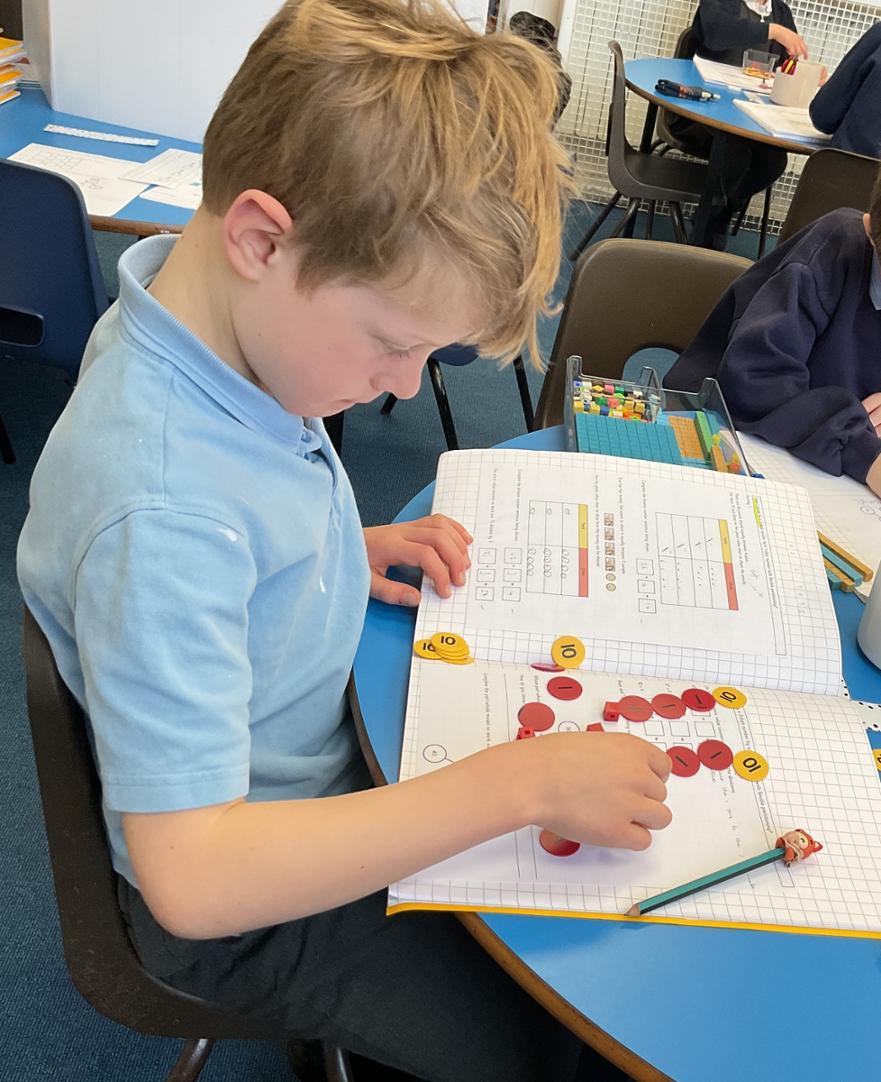
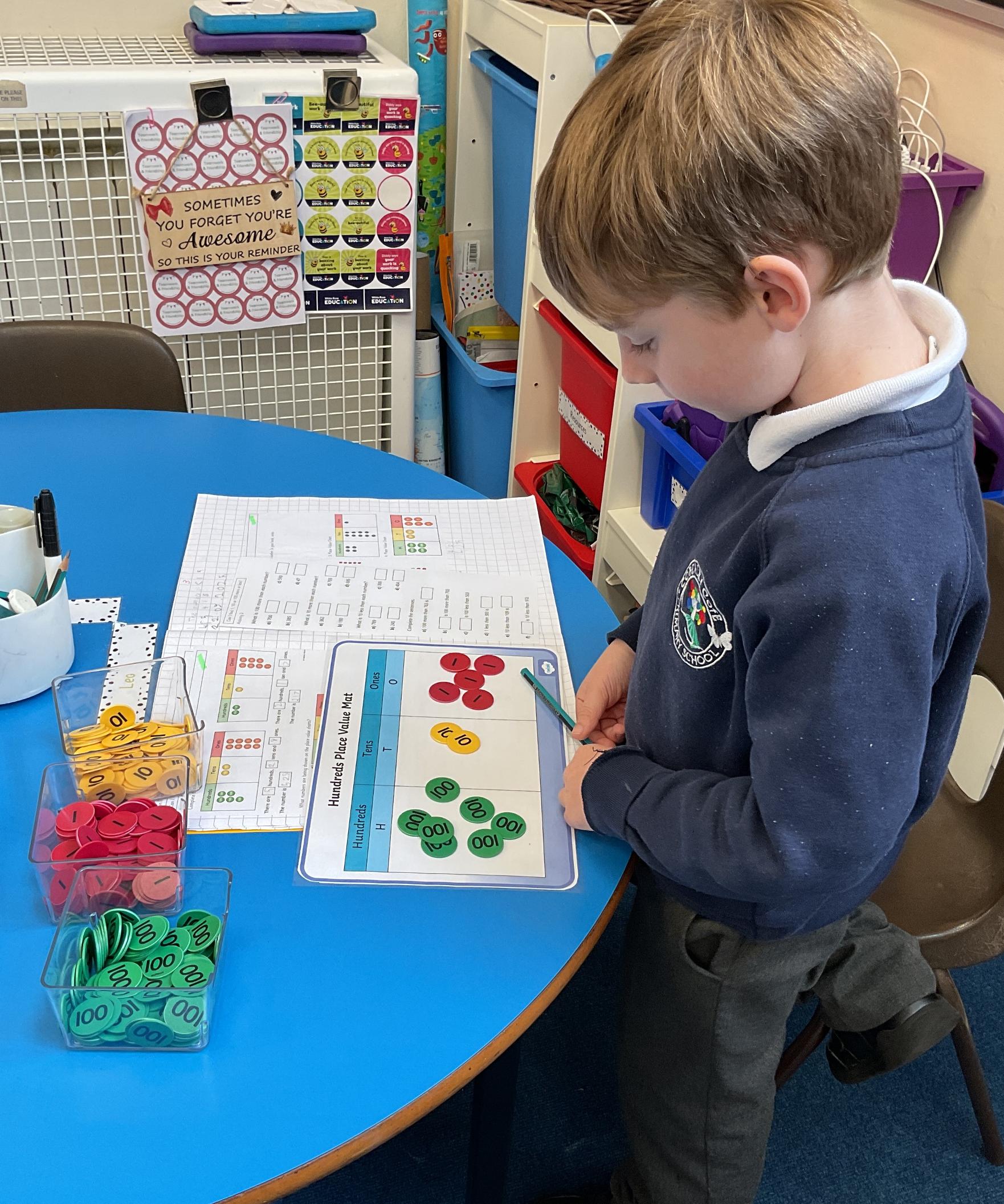
Throughout the school, pupils use a range of mathematical manipulatives and representations, including counters, base ten, place value charts, bead strings, number lines and fraction resources. These are not limited to younger children; manipulatives are used across all year groups as a scaffold to support understanding, develop reasoning and help children make connections between mathematical concepts.
Following the Concrete-Pictorial-Abstract (CPA) approach, children are encouraged to move between practical resources, visual representations and abstract methods, enabling them to develop deep and secure mathematical understanding.
Mathematical Thinking and Discussion
Our curriculum places a strong emphasis on mathematical talk. From Robins Class through to Year 6, children are encouraged to discuss ideas, ask questions, challenge misconceptions and explain their reasoning using precise mathematical vocabulary.
By sharing methods and discussing different approaches, pupils develop confidence, resilience and a deeper understanding of mathematics. We want children to view mistakes as opportunities to learn and to become independent thinkers who can reason logically and solve problems efficiently.
Our Aim
We want every child to leave Coberley as a confident mathematician who:
- Has a secure understanding of mathematical concepts.
- Can reason, explain and justify their thinking.
- Demonstrates fluency in key mathematical facts and procedures.
- Applies mathematics confidently to solve problems.
- Shows resilience when faced with challenge.
- Understands the relevance of mathematics in the wider world.
- Enjoys learning and sees themselves as capable mathematicians.
At Coberley, we believe mathematics should be engaging, meaningful and accessible to all, enabling every child to develop the knowledge, skills and confidence they need for lifelong success.